Houston Considering Community-Supported Transportation
Parker has been mayor for just over a month and is already making major waves by suggesting that Houston’s Metropolitan Transit Authority explore the possibility of free service.
Can big cities be transformed into people-friendly spaces? Look what's happening in New York. Mayor Bloomberg has also suggested introducing free public transport.
Check out this report from Pittsburgh-based blogsite 'reimagine an urban space' - which also advocates for free and accessible public transport.
FareFreeNZ editor
Yesterday Mayor Bloomberg of New York City made an historic announcement that will have wide-reaching implications for street design and public space transformation around the country.
Broadway in Times Square (42nd St. to 47th St) and Herald Square (33rd St. to 35th St) will now be permanently closed to traffic. What initially started as an experiment to improve public safety and traffic flow in May 2009 is being widely touted as an outstanding success.
The result? Traffic speeds are up on diverted routes, pedestrian and motorist injuries have plummeted (down 63%), businesses are benefiting from increased foot traffic, noise pollution is down and the area is dominated by people rather than modes of transportation.
The move to make these stretches of Broadway permanently car-free is supported by 74% of people who work in the area, according to a survey conducted by the Times Square Alliance.
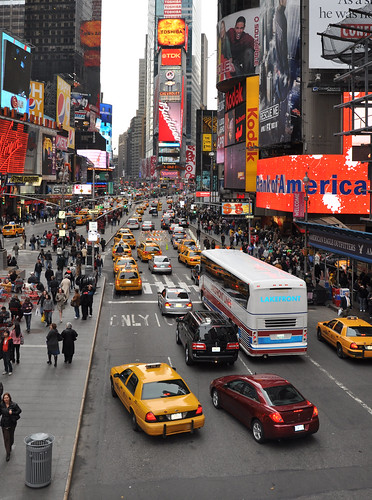
Take a look at the stark difference in the Before and After pictures of Times Square:

Times Square Before, photo by NYC DOT

Times Square After, photo by NYC DOT
The transformation has widespread support from the business community as well and was called “a 21st century idea” by Dan Biederman, director of the 34th Street Partnership (thanks to Streetsblog).
Last October I argued that temporary transformation is a more effective and legitimate way to gauge public opinion:
“People are used to roads and streets and public space being devoted to cars. That’s why it is essential to make the changes initially and give people the opportunity to feel and experience the delight of a public plaza and then to vote. New York and San Francisco are making temporary changes to demonstrate the value of returning space to people and have promised to return them to business as usual if that’s what people want.”
I’ll repeat: If you build cities for cars, you get cars. If you build cities for people, you get people.
New York did this and people love it. The rest of the country should begin following suit immediately.
The Green Party is calling on our Government to prepare for a significant oil crunch, in light of an industry led report warning the UK Government about the threat of rising oil prices.
The UK’s Industry Taskforce on Peak Oil and Energy Security has released its second in-depth analysis of the risks to the economy from the end of cheap oil.
“Our Government needs to listen to industry leaders such as Richard Branson and Brian Souter. Unlike the financial crisis, we cannot say we weren’t warned,” Dr Russel Norman, Green Party Co-Leader said today.
The Taskforce states that the impact of Peak Oil will include sharp increases in the cost of travel, food, heating and retail goods. It finds that the transport sector will be particularly hard hit, with more vulnerable members of society the first to feel the impact.
“John Key’s Government must stop and reflect on the wisdom of building more roads instead of improving public transport,” Dr Norman said.
“A key finding of the Taskforce is that oil prices will be extremely volatile and will threaten economic and social stability.
“Domestic gas, petrol and electricity prices will also be affected as people reach for alternatives. Our agriculture sector is particularly vulnerable because of its dependence on fossil fuels for fertilizer, irrigation and mechanical power.
“John Key is now on notice from the world’s industry leaders that one of the biggest threats facing New Zealand today is our dependence on oil.
“I call on the Government to convene its own taskforce and prepare New Zealand for the imminent oil crunch,” Dr Norman said.
The Industry Taskforce Report can be downloaded here:
http://peakoiltaskforce.net/download-the-report/2010-peak-oil-report/
A new Canadian website advocates for free public transport
The move towards free transit is global. Here is an item from the new Toronto website "Peoples' Transit" - check out the list of fare-free transit websites around the world in the right hand column of this site.
FareFreeNZ editor
"What if we built a green, expansive public transit? What if it were free?"
Did you know that the government has set aside $125-billion of your money to fund banks? Did you know that auto companies received $4-billion of your money in funding? that the government has created a $12-billion fund of your money to encourage car-buying to keep these companies afloat?
These banks are making massive profits. The car companies are producing cars no one wants to buy, and that additionally are big polluters and clog up our roads. These subsidies may preserve some jobs in the short-term, but thousands have already lost their auto-producing jobs and more cuts will be on the way.
Why is the government propping up the rich with the money of working people instead of reinvesting it in their interests? Why do we get fare hikes, when the rich get bailouts?
Did you know that the TTC shortfall for this year to be covered by fare hikes is just $50-million? In comparison to the big bailouts, that’s peanuts. But for working people, already paying some of the highest transit fares in North America, paying more is not an option.
What if the government spent that money on building the kind of public transit infrastructure necessary for the City of Toronto, and spent that money on keeping it operating so that more jobs were created, more people started sustainable, local businesses, and people in any part of Toronto could access any other part of Toronto?
What if we built a green, expansive, public transit?
What if it were free?
It’s doable. It would be a true People’s Transit.
Read more about People’s Transit. Tell us what you think: peoples.transit [at] gmail.com
AAP
Providing free public transport for people leaving clubs late at night could help prevent alcohol-related violence, an inquiry has heard.
A Queensland parliamentary committee is on Friday taking evidence in its inquiry into ways to tackle alcohol-related violence.
Clubs Queensland chief executive Doug Flockhart said a common sense approach was needed to stem violence, not new regulations and laws.
Mr Flockhart said governments and councils needed to treat each night of operation in entertainment precincts as a special event.
He said special events such as football matches involved free transport and other amenities.
"Complimentary transport solutions at exit times and adequate amenities in the vicinity of entertainment venues would go a long way toward improving public safety," Mr Flockhart said.
"Safely and efficiently moving people on are matters that are taken into account for a Broncos match or Riverfire, yet the large crowds that are congregating in places like the Valley, or Cavill Avenue on the Gold Coast, are largely ignored."
He said many community clubs were struggling financially and would be burdened by any new regulation.
The inquiry continues.
©
Houston Mayor Annise Parker is considering a big shake-up of the city's public transportation, including the option of transitioning to a fare-free system.
"Parker has signaled that she is not wedded to conventional wisdom about Metro, even suggesting eliminating fares to increase lagging ridership. While acknowledging that Metro would have to cope with the loss of fare revenues — $66 million in 2009, about 20 percent of its expenses — she said it is a discussion the agency needs to have.
The mayor, who appoints five of the nine members of Metro's board, said she envisions a seamless network of transportation services that move people efficiently throughout the eight-county Houston region."
Reports are due at the end of the months to help guide the region's investment in transit and transit oriented development.
Further increases to bus fares are short-sighted and will drive more Wellingtonians to use their cars, the Green Party said today.
“If the Regional Council is genuine about wanting to grow bus patronage, increasing fares by as much as 50 per cent will be a disaster,” said Green Party spokesperson Sue Kedgley.
“Lower numbers of people using the buses will lead to further fare rises, and you quickly spiral into a vicious cycle of patronage loss, service cutbacks, and further congestion on our roads as more and more people take cars rather than public transport.”
Increasing fares at a time when actual service levels are falling is another slap in the face for Wellington’s commuters, said Ms Kedgley.
“Buses frequently don’t run on time, and we’re still waiting for real time information at bus stops to tell passengers how long they will have to wait for the next bus. And a single ticket that will cover multiple trips on different modes is still a pipe dream.”
“Passengers will be left scratching their head wondering where the extra value for money is coming from with their increased fares.”
The Green Party is concerned that hidden subsidies for car drivers make driving a comparatively cheaper option over more sustainable commuting alternatives like public transport, walking, and cycling. Until the cost of driving reflects the true costs of pollution, urban sprawl, and land used unproductively for car parking, public transport will struggle to be competitive with driving.
Green’s alternative plan for Wellington’s transport problems:
http://www.greens.org.nz/transport/wellington/plan
Contact:
Sue Kedgley, MP
P 04 817 6728, M 021 270 9088
Robert Ashe, Political & Media Advisor:
P 04 817 6714