Friday, July 8, 2011

Hundreds protest Kapiti expressway

Activists say road will destroy Kapiti region

DANYA LEVY. Dominion Post 06/07/2011
NO WAY: Opponents to the Kapiti expressway protested outside Parliment today.
ANDREW GORRIE/Dominion Post
NO WAY: Opponents to the Kapiti expressway protested outside Parliment today.


They came on the train from the coast, others walked from their city workplaces and some came by bicycle.

About 300 protesters brought a colourful and vocal message to Parliament today - they do not want the Government's proposed Kapiti Expressway.

Their banners read "Rail Against The Expressway" and "Riding Rough Shot Over Kapiti'' and carried images of Transport Minister Steven Joyce and National's MP for Otaki Nathan Guy.

Forty-three homes will be demolished under the proposal and a further 33 affected under the planned route for the McKays to Peka Peka expressway.

Protest organiser Bianca Begovich said the expressway would devastate our whole district.

"It's not just about a few people losing their homes. It's about destroying Raumati, Waikanae, Otaki and Paraparaumu.''

"Environmentally it's a disaster, socially it's unacceptable and economically it doesn't stack up.''

The Government's consultation on the expressway had been a ``joke'', Begovich said.

"People don't get back to you. I've been waiting six weeks for a New Zealand Transport Agency representative to get back to me. Steven Joyce has never met publicly with anyone that's asked him to.''

The protesters presented a 4000-signature petition to Joyce and Guy asking the Government to revisit the previous proposal for a community link road.

"The community link road was a well planned, well designed road that was for Kapiti and for the greater good of New Zealand.''

MPs from all sides of the political spectrum came out of their offices to see the protesters.

Labour MP for Mana Kris Faafoi said the Government's move to cancel a public meeting on the expressway just before last year's by-election was "cynical politics''.

"I think everyone was keen to find out what the plan for the expressway was and it was proving very unpopular a few weeks out from the byelection. So all of a sudden they went quiet on the people.''

The expressway was the number one issue on the Kapiti Coast, he said.

"Nathan Guy was all for the link road before the 2008 election. The expressway wasn't even in his vocabulary. He's gone back on his word''

Green Party transport spokesman Gareth Hughes said the real beneficiaries of the expressway were the trucking industry.

Maori Party co-leader Tariana Turia said the Government had to consider the alternative route.

"Communities do need to be listened to when they feel really strongly about these issues.''

Begovich said she had invited both Joyce and Guy to meet with protesters. Neither were anywhere to be seen.

"Nathan Guy will lose his seat because of this. It's about time he listened to the community.''

- The Dominion Post


Thursday, July 7, 2011

Group puts bodies on line in bid to save rail route


No Sleepers: People opposed to a proposal to mothball the rail line from Auckland to Whangarei made their point during a mass planking protest at Whangarei's Mander Park yesterday.

No Sleepers: People opposed to a proposal to mothball the rail line from Auckland to Whangarei made their point during a mass planking protest at Whangarei's Mander Park yesterday.

Photo / John Stone

What do you get when more than 40 angry people are prepared to lay their bodies on the line to protest a proposal to mothball the rail line north of Auckland - a mass planking in the park.

Yesterday, a low-energy, ground-level planking rally organised by the Save Northland Rail group saw more than 40 people lay their bodies on the line - or should that be tracks - in a symbolic protest against the proposed mothballing.

The planking, which saw protesters lay down planking-style to symbolise the sleepers on a rail line, coincided with a nationwide day of action in support of sensible transport solutions.

Save Northland Rail spokeswoman Vivienne Shepherd said the idea was to highlight the link between massive spending on road projects for truck freight and the running down of the rail network.

The Whangarei-Auckland railway line could be mothballed indefinitely from next year, after talks KiwiRail plans to have with the region's businesses and local authorities. Mothballing would involve maintaining the line but ceasing services.

- - - - - - - - - - - - - - - - - - - - - - - - - - - - - - - - - - - - - - - -
To contact the 'Save Our Rail Northland' group:
campaign coordinator is Alan Preston.

Email: thewayforward2011@gmail.com
Cell phone: 021-02377242
Website: thewayforward2011


Wednesday, July 6, 2011

Free, frequent, clean & colour-coded: Yes! - now let's spread it over the whole city

Three Link services to make inner-city busing easier

By Bernard Orsman
Wednesday Jul 6, 2011

Auckland will soon have three Link bus services as part of an expanded and simplified network in the central city and inner-city western suburbs.

From August 21, most bus services will be banished from Queen St to make the city's premier street more pedestrian-friendly.

The only buses using Queen St will be the airport bus and a new city Link running every seven to eight minutes to Karangahape Rd and back, with every second bus going in the other direction to Wynyard Quarter.

The city Link will replace the free City Circuit bus, which carries 2200 passengers a day. The new service will be free until Christmas and then free for Hop card users and 50c for others.

Auckland Transport public transport planning manager Anthony Cross said yesterday the current city and Western Bays bus network was confusing, especially for new bus users.

The inner Link simplified the existing Link route by running it more directly through the city, Ponsonby, Karangahape Rd, Newmarket and Parnell, while the new outer Link would run in a circle that included Mt Albert, St Lukes, Mt Eden, Epsom and Newmarket.

In response to public feedback - the proposed changes in March attracted 1200 submissions - Auckland Transport changed the city routes around so the inner-city Link service now goes via Britomart and the outer Link service via Wellesley St.

Mr Cross said Western Bays areas not served by the Link buses would have two routes to the city via Albert St - one service would go to Westmere, Richmond Rd and Freemans Bay and the other to Pt Chevalier and Williamson Ave.

Auckland councillor Wayne Walker predicted there would be a quantum leap in bus patronage.

"People like to use circular routes. They are incredibly easy to understand," he said.

New Zealand Bus is spending $66 million on 158 new buses for the Link services. The vehicles are 90 per cent cleaner than diesel buses and will be painted red, amber and green.

By Bernard Orsman | Email Bernard
NZ Herald 6 July 2011


Sunday, June 19, 2011

Environmentalist for fare free public transport to cut oil consumption

Digital Journal 17 June 2011


An interview with an environmentalist and anti-deep sea drilling campaigner in the run-up to the second Hands Across The Sand in London on June 25.

The Deepwater Horizon disaster was one the greatest man-made catastrophes of the past fifty years – was and is – we still don’t know the full and ongoing effects it will have on the flora and fauna of the Gulf Coast and beyond, and even on the Gulf Stream. The eco-movement is nothing new of course, but a branch of that movement – if it may be called that – which is specifically anti-oil – is making headway in the US and in many other countries. On June 25, Hands Across The Sand is mounting its second annual event. One person who has a professional as well as a personal interest in this event and what it stands for, is Maura Flynn, an American marine biologist currently living in London. Here she is in her own words.

AB: How long have you been involved in the anti-oil campaign?
MF: Bit of an odd story. I graduated university with a degree in marine biology right into the recession. I’ve had seasonal or grant jobs here and there, but it’s been hard to find work in a field that’s been suffering from budget cuts and threats of research defunding. In March of last year, out of fears that I was becoming unfamiliar with the current events in my field, I created a blog that aggregated news articles from various places around the web with topics like marine conservation, fisheries and endangered marine species. Not even a month later, the Deepwater Horizon blowout occurred. The news was flooded with articles about the Gulf of Mexico, the marine species that would be affected by the spill, the fisheries in the area and the impacts on the marine environment. It became the topic that I wrote about the most, and through researching the articles I came across events like Hands Across the Sand.
AB: Did you take part in the last Hands Across The Sand?
MF: Yes. Last year the event received a lot of attention after Deepwater Horizon. I actually heard about Hands Across The Sand from a former university classmate of mine back in the United States, and I was very pleased to find that there was an event happening here in London as well, which I'm helping to organise.
AB: Was that organised in response to the Deepwater Horizon disaster or is it something that was in the wind long before that?
MF: Hands Across The Sand originated in Florida before Deepwater Horizon as a movement against the efforts of the Florida Legislature and the US Congress to lift the ban on near and offshore oil drilling along Florida’s coast. Deepwater Horizon drew considerable attention to the problems of offshore oil drilling, and the event took off nationally and globally from there. Last year, events took place in all 50 states and in 43 countries worldwide.
AB: What do you hope to achieved by this...protest is not the right word, but I hate to call it a publicity stunt. Action?
MF: I would call it a demonstration. My main goal is to spread awareness of the issue of offshore oil drilling and dirty fossil fuel use versus clean energy sources such as wind and solar power. Personally, I think the environmental movement has sort of a bad reputation at the moment. Oftentimes when I mention an environmental topic I’m interested in or that I’m writing about, people assume I’m some kind of “tree-hugging hippie” or a PETA member who throws blood on people. I feel like these are the two stereotypes thought of when someone thinks “environmentalist.” But really this event is just to show that normal people care about the environment too. I believe most people want to do the right thing; it’s just a matter of bringing the issue to everyone’s attention. We all want clean air, clean water, safe food resources and to pass on a good future to those who come after us. The continued use of fossil fuels and dirty energy is jeopardizing that. This demonstration is a simple way people can come together to say it’s time to move towards a cleaner energy future.
AB: Are you opposed to all drilling for oil, just drilling in the sea, or deep sea drilling?
MF: I’m not a fan of any drilling – or any activity for that matter – that degrades the environment. I am particularly opposed to drilling in the sea or in coastal areas due to the potential magnitude of a spill event. Water will carry oil to places we might not even be able to find…And then how are we to fix it? I know we can’t all stop using oil tomorrow and switch entirely to more environmentally-friendly energy sources, but I do think it’s way past time to be taking a closer look at alternative energy and investing more time and money into its research and development.
AB: What do you think are the alternatives to oil: how can we reduce consumption of oil, etc? MF: The easy answer is to use public transport and to drive less, but there’s so much more than that. Plastic production is a huge consumer of oil, so minimizing the plastic products you purchase is a great step. This includes the obvious such as bottled water and plastic shopping bags, but also things like kitchen gadgets, child’s toys and certain types of clothing. I’m not saying you can’t buy these things, but consider the materials the products you buy are made of, and perhaps move towards items made from recycled glass, sustainably sourced wood or organic cotton. Another thing is to lower your “food miles”. London has some wonderful farmers’ markets, so consider buying your groceries locally instead of at Sainsbury’s, where many products are flown in from other countries. You can also try to eat lower on the food chain – that is, eat less meat and animal products. It takes far more resources to produce a pound of beef than it does to produce a pound of veg. Why not start with introducing one or two “vegetarian days” into your week? Perhaps most importantly, take a moment to write your representatives in the government and tell them how you feel about your country’s oil usage and that it’s time for a change.
AB: What is your view of synthetic oil and other alternatives?
MF: At the moment I don’t know very much about this, but it is a topic I’m looking in to. I know there is currently a debate about biofuels like corn oil because it’s taking food resources that hungry people could benefit from and using them to power luxury items like cars.
AB: How do you feel about a totally fare-free public transport system and similar measures to reduce oil consumption?
MF: I have to say, as an American from a small town where everyone has cars coming to a big city like London with multiple public transport systems…I love it! Everything is so easy to get to, and there’s never any traffic. On top of that, I’m a fan of public transport because it lessens the number of cars on the road. If you know a bus or train is already going to your desired destination, why not just hop on and save yourself the frustration of traffic and tolls? Making it fare-free would just sweeten the deal.

Friday, June 17, 2011

Leave the car in the garage - could save you $10,000 a year

Pocatello Transit Wants You To Dump The Pump

POSTED: 4:47 pm MDT June 16, 2011

Transit officials want locals in Pocatello to dump the pump and, in the process, save a little cash.

Thursday is national Dump the Pump Day, and Pocatello Regional Transit is hoping to entice more people to take the bus instead of their car.The PRT has begun handing out small flyers, and will continue through the week.

They give the holder a full free month on Pocatello public transportation.Transit officials said if you haven't considered taking the bus in Pocatello recently, look again. Routes have been expanded and schedules improved.

They said if you can take advantage of public transport enough to get a rid of a car, it'll save the average family about $10,000 a year.

...hey - this public transport thing might be the way to go!

Free Rides In Honor of Dump the Pump Day

on Thursday, June 16, 2011 at 11:30 AM

Today is the sixth annual National Dump the Pump Day, a day meant not only to raise awareness of our dependence on foreign oil, but also to remind us of the benefits of public transportation. We all understand that public transit reduces congestion, but did you know that transit use in the United States saves 4.2 billion gallons of gasoline each year and that every dollar invested in transit generates about $4 in economic returns? These are just a few of the benefits the American Public Transportation Association is highlighting this year. APTA is also encouraging transit agencies across the country to offer free rides.

IndyGo of Indianapolis, where transit ridership is up 13.6 percent over May 2010, is offering free rides today on all lines except their downtown/airport express line. Dump the Pump Day couldn’t come at a better time for Indianapollis, where the Central Indiana Regional Transportation Authority and transit advocates are trying to persuade the Hoosier State’s GOP-heavy legislature to put a new tax for rail on the 2012 ballot.

LexTran, the transit agency in Lexington, Kentucky, is unveiling its new hybrid buses in addition to offering free rides. Space Coast Area Transit in Brevard County, Florida, is offering free rides too, but riders have to go online and print a ticket.

Offering free rides might be a way to attract riders who are on the fence about riding transit for everyday trips, but one can’t help but wonder what’s the long term impact of an initiative like Dump the Pump. Sure, raising awareness is important, but it seems like the only way to really increase transit ridership is to hit drivers in the wallet.

...aren't drivers are being "hit in the wallet" already with rocketting fuel costs? It's time to cut the red tape and penalties - limited free transit days are a good promotion, but permanent city-wide, free & frequent modern public transport is the way to get commuters out of our cars, increase mobility and cut car pollution, traffic congestion, road accidents and wasting precious fossil fuels - big time. Ed.

Thursday, May 26, 2011

Free bus services in Gibraltar

GOVT INTRODUCE FREE BUS SERVICE FOR ALL

Gibraltar Government yesterday announced the restructure and shortening of bus routes plus the introduction of a free bus service for all on all routes with the exception of the frontier route. In a statement to the Chronicle, Minister for Transport Joe Holliday said these measures will bring about “a significant improvement in transport infrastructure, traffic flow and parking in Gibraltar.”

Commenting on the introduction of these new routes, Mr Holliday said: “In addition to the on going construction of car parks and parking schemes, traffic management, new roads and other initiatives that are currently being implemented, these new bus routes will provide for a significant improvement in transport infrastructure, traffic flow and parking in Gibraltar.

“The introduction of free bus fares on four of the five routes, is aimed at encouraging the increase in use of public transport and therefore a decrease in the use of private motor vehicles, so as to deliver an environmental gain, as well as improved traffic circulation. The introduction of the new bus routes and free bus service on most routes will represent further significant progress of the Plan.”

A statement by the Ministry of Transport said: “The Government will be introducing a new bus service as stated in its Integrated Traffic, Parking and Transport Plan and as part of its manifesto commitments, on Saturday 28th May 2011.

“The current routes have been reviewed and new routes will be introduced that are more consistent with an efficient and modern bus service that provides for point to point transport. The new routes will have as their main terminus the Market Place bus stop.

“The new routes will be numbered from 1 to 5. In keeping with the Government’s commitment to introduce a free bus service, routes 1, 2, 3 and 4 will provide a free service for all passengers at all times. Routes 1 to 4 will cover all points in Gibraltar, except a journey to and from the frontier.

“Route 5, which will be operated jointly by the Gibraltar Bus Company Limited and Calypso Transport Limited, will be the only fare paying route. This route will operate from the Frontier via Market Place to Reclamation Road and return to the frontier via Europort Avenue, Waterport Road and Market Place

Gibraltar Chronical 26 May 2011.

Tuesday, May 17, 2011

Rail against the express way

The Kapiti coast, north of Wellington, is faced with one of the government's "roads of significance", due to be bulldozed through the district despite a more logical, less expensive & community-friendly alternative.
Locals want their rail services & stations upgraded.
"Save Kapiti" has called for a protest rally at Parliament, Wellington on Wednesday 6 July from midday.

JOIN US TO MARCH OR MEET US AT THE STATION:

9AM: RED HOUSE CAFÉ, TE HORO
9:30AM: MELT CAFÉ, WAIKANAE TE RA SCHOOL, RAUMATI
10AM: KCDC, PARAPARAUMU WHAKARONGOTAI MARAE, WAIKANAE
11AM: WAIKANAE STATION PARAPARAUMU STATION PAEKAKARIKI STATION
12PM: PARLIAMENT GROUNDS, WELLINGTON
(AND 10AM BASIN RESERVE, HATAITAI FOR THOSE OF YOU JOINING US IN WELLINGTON)
• Roads of National Significance (RoNS) – roads built for trucks, not for Kiwis
• Decisions made without honest public consultation
• Built with borrowed money funded by State Assets?
• There are proven safer, more efficient solutions
• Join over 4000 petition signers for a March on Parliament
Save Kapiti
TO FIND OUT HOW TO BOOK OR FOR MORE INFORMATION email: contact@savekapiti.co.nz or phone 021 641 123
And don’t forget to ‘vote with your vote’ - Vote against the expressway at the November election.

Check out the website: www.savekapiti.co.nz

Tuesday, May 10, 2011

HEI study finds London Congestion Charging Scheme shows little evidence of improving air quality

27 April 2011

The London Congestion Charging Scheme (CCS)—which charged for travel into central London and reduced traffic volume (earlier post)—has shown little evidence that it improved air quality as well, according to Part I of a new study published by the Health Effects Institute (HEI). The study, “The Impact of the Congestion Charging Scheme on Air Quality in London”, was led by Professor Frank Kelly of King’s College London as part of HEI’s research program to measure the possible health outcomes associated with actions taken to improve air quality.

Although the London CCS was designed to improve traffic and not necessarily air quality, early projections had suggested it could also improve air quality. Kelly and his team used a multifaceted approach to explore the impact of the Congestion Charging Scheme on air quality: a variety of emissions and exposure modeling techniques, analysis of air monitoring data, and a newly developed assay for the oxidative potential of particulate matter collected on filters at urban background and roadside monitors. Part I of the report deals with emissions modelling and analysis; Part II, to be released next month, analyzes the oxidative potential of PM.

The CCS offered an unusual opportunity to investigate the potential impact on air quality of a discrete and well-defined intervention to reduce traffic congestion in the middle of a major city. The CCS was implemented in London in February 2003 with the primary aim of reducing traffic congestion by charging vehicles to enter the central part of London, defined as the congestion charging zone (CCZ).

In an earlier study based on data from the first year of the scheme, members of the investigative team had reported early findings of modest reductions in the number of vehicles entering the zone and had projected declines of about 12% in emissions of both PM10 (particulate matter with an aerodynamic diameter of ≤10 µm) and nitrogen oxides (NOx) within the CCZ.

—Kelly et al.

The investigators did not find consistent evidence of improved air quality resulting from the CCS. In part it is difficult to identify significant air quality improvements from a specific program—especially one targeted at a small area within a large city—against the backdrop of broader regional pollutant and weather changes.

Within the CCZ, the investigators projected a net decline of 1.7 ppb in the annual average mean NOx concentration and a decline of 0.8 µg/m3 in PM10. The modeling also suggested that a major proportion of PM10 might be accounted for by regional background levels, but that contributions from tire and brake wear might also be important. NO2 was projected to increase slightly, by 0.3 ppb on average; the investigators attributed this increase to higher NO2 emissions associated with the introduction of particle traps on diesel buses as part of Transport for London’s improvements in the public transport system.

From their comparison of actual air pollutant measurements within the CCZ with those at control sites in Outer London, the investigators reported little evidence of CCS-related changes in pollutant levels at roadside monitoring sites, where their modeling had suggested the most pronounced effects would be seen.

—Kelly et al.

Also, some behavioral adjustments among the population, e.g. increased diesel-powered taxi and bus trips to transport people into the zone, may have offset any benefits. Finally, other changes occurring at the same time (e.g. the introduction of more filter-equipped diesel buses in response to a separate rule) likely also affected air quality and obscured effects of the CCS.

The Congestion Charging Scheme was one of the first to be implemented in a major city in Europe or the US—and did show measurable reductions in traffic volume—but air pollution does not know precise boundaries so any benefit of the CCS or air quality appears to have been lost in the larger regional pollution mix.

—Dan Greenbaum, HEI’s President

Overall, HEI’s Review Committee concluded that Kelly and colleagues’ investigation represents a creative effort to explore a subtle change in air quality associated with a complex intervention to reduce traffic congestion. Although they were unable to demonstrate a clear effect of the CCS either on individual air pollutant levels or on oxidative potential of particulate matter, their study offers lessons for future studies of interventions that are expected to influence air quality.

The London Congestion Charging Scheme was a world leading traffic intervention aimed at controlling excessive vehicle flows in central London. The findings reported in this HEI study will hopefully be of use to other administrations considering introducing traffic management schemes so that they can achieve vehicle reductions as well as improving air quality at the same time.

—Professor Frank Kelly

In addition to the Investigators’ Report by Kelly et al., Research Report 155 includes a Commentary by HEI’s Health Review Committee, which summarizes its independent review of the study and an HEI Statement that provides a nontechnical summary of the study and the committee’s comments.

The Health Effects Institute is an independent, non-profit research institute funded jointly by government and industry to provide credible, high-quality science on air pollution and health for air quality decisions. Typically, HEI receives half of its core funds from the US Environmental Protection Agency and half from the worldwide motor vehicle industry. Other public and private organizations periodically support special projects or certain research programs.

HEI has funded more than 280 research projects in North America, Europe, Asia, and Latin America, the results of which have informed decisions regarding carbon monoxide, air toxics, nitrogen oxides, diesel exhaust, ozone, particulate matter, and other pollutants. These results have appeared in the peer-reviewed literature and in more than 200 comprehensive reports published by HEI.

Resources

Frank Kelly, H. Ross Anderson, Ben Armstrong, Richard Atkinson, Ben Barratt, Sean Beevers, Dick Derwent, David Green, Ian Mudway, and Paul Wilkinson. The Impact of the Congestion Charging Scheme on Air Quality in London. HEI Report # 155

_ _ _ _

Alright ...so punitive measures don't work ... hey! - so how can we make car & oil dependency history & create healthy cities? ....what about fare free public transport! ....make it so attractive that no sane person would even consider driving around by car unless it was absolutety essential.... mmmm; yeah, but how would those poor oil companies survive?

FareFreeNZ editor

Thursday, May 5, 2011

Capitalism's war on the Earth

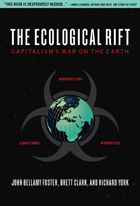
The ecology of consumption -- excerpt from John Bellamy Foster, Brett Clark and Richard York's `The Ecological Rift'

October 20, 2010 -- Links International Journal of Socialist Renewal, with the permission of Monthly Review Press, is excited to offer its readers an excerpt from the The Ecological Rift: Capitalism’s War on the Earth, an important new book by John Bellamy Foster, Brett Clark and Richard York. Links' readers are urged to purchase the book. Please click here to order your copy. You can download (in PDF) the chapter, "The ecology of consumption", below the following introduction, or read it on screen.

* * *

Humanity in the 21st century is facing what might be described as its ultimate environmental catastrophe: the destruction of the climate that has nurtured human civilization and with it the basis of life on earth as we know it. All ecosystems on the planet are now in decline. Enormous rifts have been driven through the delicate fabric of the biosphere. The economy and the Earth are headed for a fateful collision—if we don’t alter course.

In The Ecological Rift: Capitalism’s War on the Earth, environmental sociologists John Bellamy Foster, Brett Clark and Richard York offer a radical assessment of both the problem and the solution. They argue that the source of our ecological crisis lies in the paradox of wealth in capitalist society, which expands individual riches at the expense of public wealth, including the wealth of nature. In the process, a huge ecological rift is driven between human beings and nature, undermining the conditions of sustainable existence: a rift in the metabolic relation between humanity and nature that is irreparable within capitalist society, since integral to its very laws of motion.

Critically examining the sanguine arguments of mainstream economists and technologists, Foster, Clark and York insist instead that fundamental changes in social relations must occur if the ecological (and social) problems presently facing us are to be transcended. Their analysis relies on the development of a deep dialectical naturalism concerned with issues of ecology and evolution and their interaction with the economy. Importantly, they offer reasons for revolutionary hope in moving beyond the regime of capital and toward a society of sustainable human development.

John Bellamy Foster is editor of the US-based Marxist journal, Monthly Review. He is professor of sociology at the University of Oregon and author of The Ecological Revolution, The Great Financial Crisis (with Fred Magdoff), Critique of Intelligent Design (with Brett Clark and Richard York), Ecology Against Capitalism, Marx’s Ecology, and The Vulnerable Planet.

Brett Clark is assistant professor of sociology at North Carolina State University. He is coauthor (with John Bellamy Foster and Richard York) of Critique of Intelligent Design.

Richard York is associate professor of sociology at the University of Oregon. He is co-editor of the journal Organization & Environment and coauthor (with John Bellamy Foster and Brett Clark) of Critique of Intelligent Design.

* * *

Click HERE to download (PDF) "The ecology of consumption" or read it on screen below.

"The ecology of consumption", by John Bellamy Foster, Brett Clark and Richard York