Thursday, August 23, 2012

Post-fossil Conversion & Free Public Transport

Extracts from a recent German analysis

By Michael Brie and Mario Candeias.
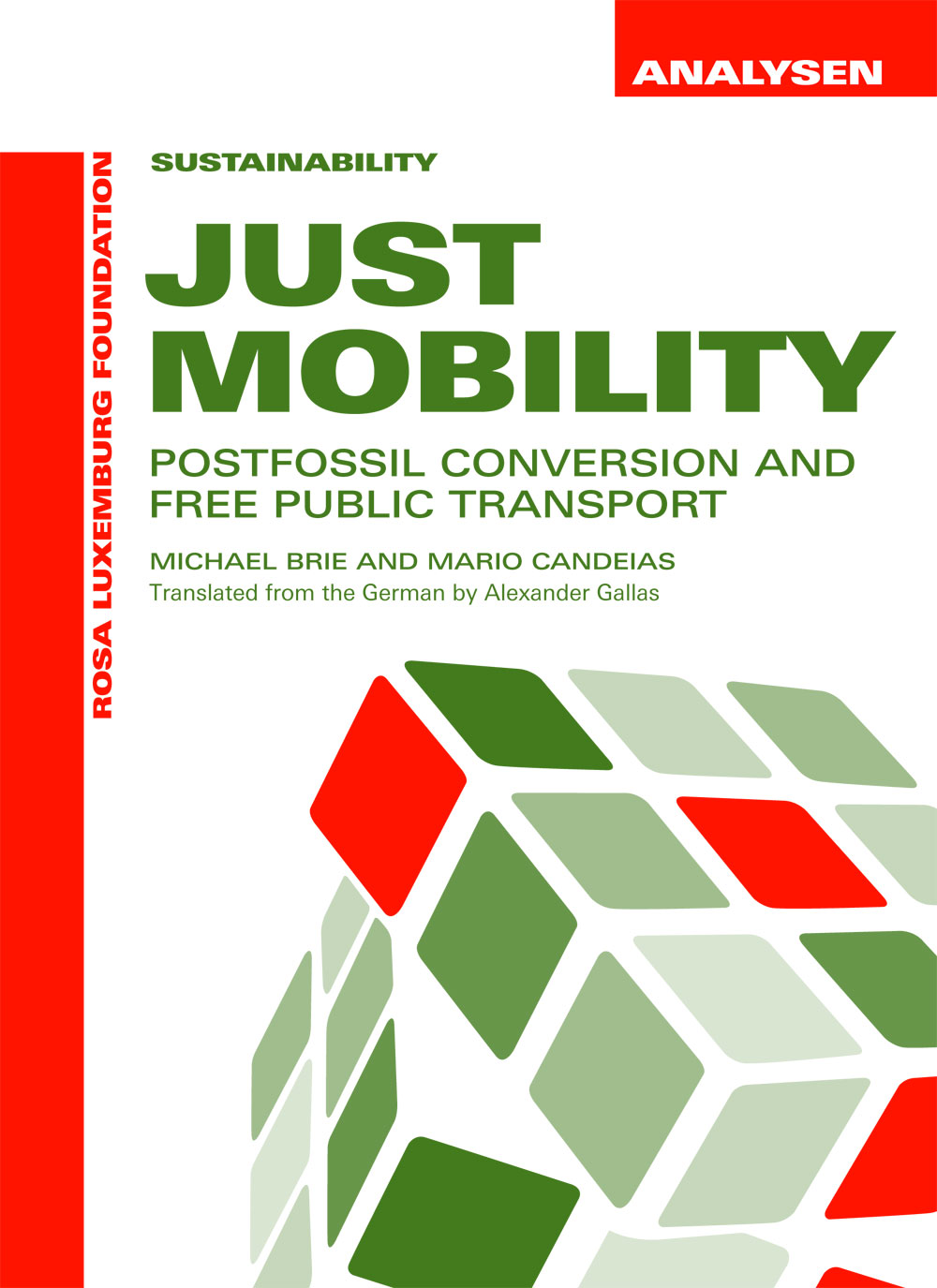


"A free public transport system is part of a process of transformations toward a Green Socialism ..and the earth would become a home."


Part I.
Private E-Car vs. Public Transport for free – Real Dystopia vs. Concrete Utopia
Michael Brie
Crises create opportunities to set long-range goals for the future. A key question is that of urban mobility in a world in which the great majority of the world’s population will soon live in cities of over a million inhabitants, many of them in metropolitan conurbations.
Broadly speaking, there are two possible alternatives: one, the US system of mobility centred on private, petrol-driven cars can be ecologically modernized and expanded to embrace the globe by switching to electric-powered cars; or, two, public transport can be ecologized and made more flexible.
For historical reasons the factors determining which of these alternatives will be chosen are very different and path-dependent. Whereas rapid transit systems have largely disappeared from many US metropolises, European metropolises are characterized by mixed systems. In many metropolises of the southern hemisphere the car-based mobility of the rising middle classes coexists with the exclusion of large sections of the city-dwelling poor from urban mobility. Long-term experiments with a free-of-charge public transport system could act as a global model.

Part II.
Conversion.
Towards a Eco-Socialist Economy of Reproduction
Mario Candeias
How to get from here to there? A Free Public Transport system is deeply connected to the conversion of the car industry and specific modes of dealing with contradictions of a transformative process. The car industry is facing strong challenges between crisis of overproduction, booming demand from «emerging markets’, spatial relocation and ecological necessities. Conversion and a just transition for the workers and communities affected face several strategic dilemma. The paper elaborates on union and (eco)movement strategies and short comings, trying to draw on a political method and projects, which create communalities out of different interests at the same time as appreciating differences. The protagonist of such a process of transformation towards a Green Socialism can only be a «mosaic left» oriented towards participation, which enables people to become «the drivers of their own history» (Eric Mann 2001)


Wednesday, August 22, 2012

International conference to discuss introduction of free public transport in Tallinn, Estonia, & other EU cities

"Free public transport in Tallinn – a brave step towards the green capital"


Smart and green growth forum
Tallinn 26 October 2012: International Conference Tallinn City.

The City of Tallinn/Estonia has a challenging project to start providing free public transport to its residents from January 1, 2013. With this step, Tallinn will safeguard social cohesion of local community granting equal mobility opportunities to all social strata. For many car drivers, free public transport will be a major incentive to switch to public transport thus reducing pollution and noise, and, in the long run, this will improve living standards of all citizens.

The conference in Tallinn on October 26, 2012 aims at bringing together representatives of local and regional governments, practitioners and stakeholders to discuss in an open forum the challenges, problems and opportunities of such initiative. We introduce the project of free public transport in Tallinn, share experiences of the cities that have already implemented free public transport (fully or partly) in urban areas, as well as generate discussion with other EU capitals and metropolis, partner cities of Tallinn and cities, active in international organizations and networks focusing on transport and environment issues.

Target groups of participants:
Capitals and metropolis, partner cities of Tallinn and cities, active in international organizations and networks focusing on transport and environment issues, representatives of local and regional governments, practitioners and stakeholders to share experiences of the cities that have already implemented free public transport (fully or partly) in urban areas.

More information:
www.tallinn.ee/freepublictransport

Monday, August 20, 2012

Electric cars will save us all: Yeah right!

Written By: - Date published: 10:09 am, June 1st, 2012 - 53 comments
Categories: sustainability, transport - Tags: 

You know how, whenever someone points out that spending $12 billion on highways that make no economic sense makes even less sense when you consider that people are driving less because of the price of petrol and will only reduce their driving more in the face of even higher petrol prices, some idiot says ‘we’ll just invent alternatives, drive electric!’. Yeah, it ain’t happening.

Leaving aside the problem that there’s not enough lithium producable for all the batteries we would need, there’s just no way that the take-up of electric cars is going to be sufficiently fast to make a big difference to the oil-intensity of driving in New Zealand.
There are 46 electric cars registered in New Zealand, out of 3.4 million. That’s up from 25 in 2007. At the current (let’s assume exponential) rate of increase, it will reach 350 by 2022.
By that time, petrol prices will be $5 a litre.
Even if every car registered from now on was electric (and that wouldn’t be possible even if New Zealand bought the world’s whole electric car production), over half the fleet in 2022 would be oil-driven because most cars that will be on the road in 2022 are already on the road. The average age of the car fleet is 13.59 years and that’s increased by 1.5 years in the past five years and 2 years in the past ten.
People aren’t responding to high oil prices by buying electric cars: they’re responding by keeping their old cars and driving them less (traffic volumes have been falling for nearly all of the past four years and vehicle kilometres travelled are down about 7% per capita from peak)
MoT projects that 85-90% of vehicles will still be conventional in 2030. Indeed, the likelihood of ongoing weak growth and high fuel prices leaves businesses and families with less capital for investment in new vehicles.
All of which makes the daydreams of people who say ‘yeah, we should spend $12 billion on uneconomic roads, because we’ll all drive on them in electric cars’ even more fanciful.

From 'the Standard' 1 June 2012

Friday, August 17, 2012

Transport dominates every aspect of our lives, our health, the form of our communities, our environment, economy and our personal financial well-being.
Smart Transport means providing a full spectrum of appropriate, sustainable and integrated transport choices.
The Smart Transport Network has been formed following the Smart Transport Conference, held in parliament buildings in August 2011, to present a new collective national voice, with an international perspective on transport solutions.
The Smart Transport Network will advocate for smart, modern solutions and development that make more efficient use of transport spending and encourage infra structural priorities that will serve the community now and into the future.
Smart transport choices..
  • are integrated, universally accessible, and not private car dependent,
  • will be viable now and in the future, and less dependent on overseas resources,
  • are affordable for governments and individuals,
  • enable resilient communities and individual independence,
  • support good public health, particularly in terms of obesity and air pollution,
  • are environmentally sustainable, reducing our carbon footprint,
  • include institutional goals for mode shift, with achievable medium term benefits.
The Network is already backed by: Cycling Advocates NetworkWWF New Zealand350 Aotearoa, Greenpeace, Rail and Maritime Transport UnionBrakePublic Transport Voice, along with many local issue groups such as Save Kapiti, Cycling Auckland, TransAction, and Save Our Rail – Northland.

All electric, fare free bus fleet for South Carolina city:

Seneca city bus company honored at White House » Anderson Independent Mail: "Foothill Transit was the first to put the all-electric bus to work in its fleet about three years ago. In 2013, Seneca intends to switch its entire gas-powered buses to an electric fleet. Seneca city administrator Greg Dietterick attended the ceremony. He said it offered a chance to publicize the fact that in 2013, Seneca will become the first all electric, fare-free, public transit fleet in the nation. Dietterick said the city will soon be hosting visitors from across the globe, wanting to see an all-electric bus fleet in action."

Tuesday, May 1, 2012

Bus driver's death evokes call for free public transport

The NZ Herald published this letter from Fare-Free NZ editor, Roger Fowler today. The letter was written in the aftermath of the shocking assault and death of a Lower Hutt bus driver, Herman Curry, on Friday. His cashbox was later found minus about $30 - $50 bus fares.
Many bus drivers have experienced threats, assaults and robberies. If public transport was fare-free & cashboxes were removed, drivers could concentrate on their job: getting their passengers to their destinations promptly & safely - without the constant fear of such attacks.

On Public Transport

Collecting fares is a time-consuming, expensive and often dangerous method of paying for public transport.

Now, a bus driver has paid the ultimate price.

It is time to consider mass mobility as an important public service, like libraries. We should all share the costs and benefits.

Eliminate fares and upgrade public transport to get commuters out of cars, cut congestion, and make travel safer.


Roger Fowler,

Mangere East.


Tuesday, April 10, 2012

German drivers offered free public transport

Germany map

Motorists in the German city of Leipzig are to be offered free public transport this week in a bid to cut congestion.

The authorities' decision comes amid concerns over commuting times and lengthening traffic jams.

The hope is that motorists will be persuaded to leave their cars at home permanently.

They will have to produce vehicle or driving licences. Families and groups can also travel together on a single document.

Rising fuel prices in Germany have led to recent calls for the tax on petrol to be cut, although commuters are already able to offset their journeys to work against income tax.

BBC Europe News 10/4/2012


Friday, March 23, 2012

Submission to Auckland Transport Plan

Submission on the key transport challenges and priorities for the Auckland region.

With the past & current emphasis on catering for cars and building more & more roads, traffic congestion and resulting pollution, health & other problems are having a serious, detrimental impact on Auckland, and this can only get worse as the population and vehicle-use grows.

There needs to be a substantial shift from cars to public transport.

I submit that to acheive this big shift in mobility modes and outlook, the Auckland Council should urgently consider introducing fare free public transport across the region.

This should be accompanied with an immediate halt to all spending on extravagent roading projects & diverting these funds to the free public transport programme, purchase of a large fleet of modern, low-emission buses, upgraded electric train services & ferries, improved public transport traffic flow measures, and passenger and walking & cycling amenities across the region.

Simple colour-coded integrated routes should be introduced to make public transport easily accessible to all, and allow for an easy, seamless switch from one route to another. Buses, ferries & trains should run at frequent intervals. Services should run 24/7. 'Public Transport Ambassadors' should be engaged to assist passengers, discourage anti-social behaviour, and allow drivers to concentrate of safe driving.

With a massive PR promotion, fare-free & frequent public transport could rapidly attract a large proportion of people out their cars and onto public transport.

This would have a major impact on reducing the road toll (deaths & injuries), reducing pollution & related issues, such as respiratory illnesses & stress, big reduction in wasted time sitting on gridlocked roads, big reduction in fuel costs and wastage, reduction in road maintenance costs, reduce the need for parking, eliminate the need for expensive fare collecting systems, and greatly increase the ability for Aucklanders to move about their city safely & easily.

Thank you,

Roger Fowler
5 Tennessee Ave,
Mangere East
Auckland 2024.

[Submitted Friday 23 March 2012]

Tuesday, March 6, 2012

Tallinn Receives Swedish Free Public Transit Award

Photo: Postimees/Scanpix

See Also

Tallinn's free transportation initiative has won the city an award by a Swedish NGO, Planka.nu.

The award, founded in 2010, has been handed out to organisations, individuals or cities that have made a notable contribution to changing urban traffic policies towards the better.

"Tallinn has shown that there are alternatives to the current model of fee-/ticket-financed public transport which would also lead to great benefits from a climate and resource perspective," Anna Nygård of the award committee said in a statement.

The award will be presented to Tallinn officials during the city's transportation referendum held from March 19 to 25.

If passed, the law implementing free public transportation in Tallinn would become effective beginning in 2013, the city government has said.

Erkki Sivonen

Thursday, March 1, 2012

Beijing introduces free public transportation plan for the disabled
Global Times | March 01, 2012 00:50
By Xu Wen

Beijing transportation authorities and the city's association for disabled people have announced that the disabled from today on will be able to enjoy free public transportation.

The Beijing Municipal Commission of Transport (BMCT) and Beijing Disabled Persons' Federation (BDPF) said in a press conference Tuesday that, in addition to buses, blind people may ride subways for free.

Beneficiaries only need present their certificate of disability issued by the China Disabled Persons' Federation to enjoy the specialized services, the China News Service reported.

An official with the BMCT indicated that the free rides for the disabled would be on buses with initial digits from 1 to 9, as well as the express 101 and 102 buses, and routes to remote counties and districts. The blind are also allowed to have one person to accompany them on subway lines for free.

"Disabled persons are also permitted to carry on board with them their indispensable equipment free of charge, but it must be stressed that all disabled persons ensure their certificate photo is clear so that identification can easily be made," the official said.

"The new policy applies to not only local Beijing residents, but also to disabled people from other cities," Li Caimao, director of the policy research center at the BDPF, told the Global Times.

Zhou Huibiao, a 26-year-old physically disabled man who works at a technology company in Beijing, told the Global Times that he felt the measures highlighted the government's concern for disabled persons.

Although it will decrease transportation costs for the disabled, Zhou believes it is not enough to help the physically disabled people move around, as there are few specialized accessible doors on public buses in Beijing.

Cheng Jiyong, a disabled entrepreneur in Beijing, told the Beijing Daily that the measures will really benefit the disabled, and recommended disabled persons avoid the use of public transportation during rush hours.